TL;DR

Get home office essentials delivered free with Prime
- Fast, free delivery on millions of items
- Prime Video, Amazon Music and more included
- Member-only deals all year
Reserve Bank of Australia Governor Michele Bullock told a Senate committee on October 28 that inflation is likely to be higher than the RBA’s August forecast, as Middle East conflict lifts energy costs and domestic capacity pressures persist. The RBA has raised its cash rate target by 25 basis points since the committee’s June hearing, bringing the year’s cumulative increase to 100 basis points.
Reserve Bank of Australia Governor Michele Bullock told a Senate committee on October 28 that inflation is likely to run higher than the RBA’s August forecast, citing renewed energy-price pressure linked to the Middle East conflict and continuing domestic capacity constraints. Since the committee’s previous hearing in June, the Monetary Policy Board has raised the cash rate target by 25 basis points, taking the cumulative increase this year to 100 basis points.
In her opening statement to the Senate Economics Legislation Committee’s supplementary budget estimates hearing, Bullock said the rate decision was intended to return inflation to target. The RBA aims for inflation to return to the midpoint of its 2–3 per cent target range, while also taking account of its full-employment objective. Bullock said inflation should not remain above target for too long because it could become embedded in expectations and affect price- and wage-setting.
Inflation fell from a peak of 7.9 per cent at the end of 2022 to within the target band for a period in 2024 and 2025, after monetary policy tightened in 2022 and 2023. It then picked up in the second half of 2025 and has remained above target. Bullock said inflation had recently been around 3½ to 4 per cent year-ended.
The RBA’s August Statement on Monetary Policy had projected inflation would return to around the target midpoint in late 2027. Bullock said developments since then pointed to inflation being higher than that base case. She cited sharply higher global energy prices, which can affect prices directly and through businesses’ transport and other costs, as well as pressures on agricultural and technology-related prices from extreme weather and the global AI boom.
Rate Decisions Face Renewed Inflation Pressure
The statement signals that the RBA sees a more difficult path back to its inflation objective than it did in August. Higher energy costs can feed into household prices and business expenses, while domestic demand and capacity pressures may keep underlying inflation elevated. Bullock said a further period of subdued aggregate-demand growth was needed to reduce those pressures and bring inflation down sustainably.
For households and businesses, the immediate relevance is that the effects of recent rate increases are still working through the economy. Bullock said monetary policy operates with a lag, so the full impact of the latest increases has not yet been felt in domestic activity. The statement does not announce a new rate decision; it sets out the RBA’s assessment and the reasons it says inflation remains a concern.
Products Worth Considering

LG UltraGear 27-Inch QHD OLED Gaming Monitor, 240Hz, 0.03ms, G-SYNC Compatible, FreeSync Premium Pro, HDMI 2.1

LG 34GX90SA-W 34-inch Ultragear WQHD OLED Curved Gaming Monitor

Samsung 27-inch Odyssey OLED G6 QD-OLED QHD Gaming Monitor
As an affiliate, we earn on qualifying purchases.
Inflation and the Cash Rate
The RBA’s monetary policy objective combines price stability with full employment. Its stated approach is to bring inflation back to the midpoint of the 2–3 per cent range while allowing some flexibility over timing to account for employment. The cash rate is the central bank’s main policy instrument for influencing economic conditions.
At the committee hearing, Bullock also outlined the RBA’s broader responsibilities: supporting financial-system stability, maintaining a reliable and competitive payments system, providing banking services to government agencies, and distributing secure banknotes. The supplied statement text begins an update on payments and cash distribution but does not include the detail of that discussion.
“Inflation will therefore likely be higher than was our base case in August.”
— Michele Bullock, RBA governor, in her opening statement
Forecast Risks Still Developing
The statement does not provide a revised numerical inflation forecast or specify how much higher inflation may be than the August projection. It also does not set out a future rate path or announce another cash rate decision. The timing and scale of any further policy response remain unclear.
Bullock said economic growth was slowing as expected, while household spending growth was moderating gradually and business investment had picked up strongly, driven mostly by data-centre spending. The supplied source text ends partway through that discussion, so it does not establish the complete assessment of growth, employment, or the RBA’s payments and cash-distribution updates.
RBA Policy and Committee Scrutiny
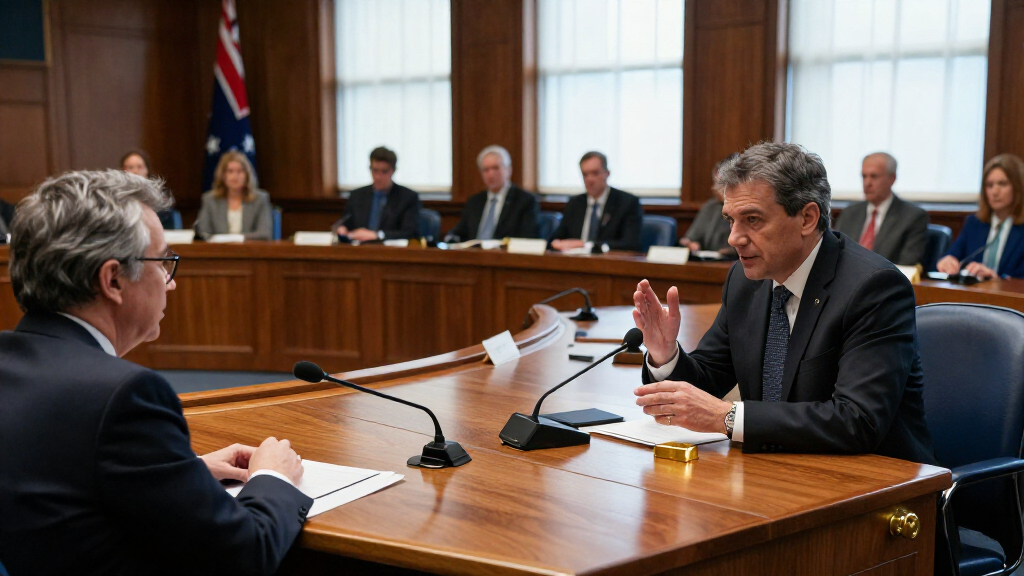
Bullock and her RBA colleagues appeared before the Senate Economics Legislation Committee to answer questions. The committee hearing provides lawmakers an opportunity to scrutinise the bank’s economic assessment and wider responsibilities; the opening statement itself does not record the committee’s questions or the governor’s subsequent answers.
The next key policy information will come through the RBA’s future monetary policy decisions and published economic forecasts. Those will show how the bank assesses changing inflation, energy prices, demand and capacity pressures. No date or specific decision is given in the supplied statement.
Key Questions
What did Michele Bullock tell the Senate committee?
She said inflation was likely to be higher than the RBA’s August forecast, pointing to energy-price increases and ongoing domestic capacity pressures.
How much has the RBA raised the cash rate this year?
Bullock said the board had increased the cash rate target by 25 basis points since the committee’s June hearing, bringing the cumulative increase this year to 100 basis points.
What is the RBA’s inflation target?
The RBA aims to return inflation to the midpoint of its 2–3 per cent target range, while also taking account of its full-employment objective.
Did the statement announce another rate increase?
No. The statement reported a previous 25-basis-point increase and discussed the inflation outlook. It did not announce a new rate decision or specify a future rate path.
Source: bis.org