

Gold bullion coins for investors differ in purity, recognition, and the premium attached to special finishes or grading. I rank the Canadian Gold Maple Leaf as the best overall for its 24-karat gold and straightforward bullion focus, while the American Gold Eagle stands out for U.S. market familiarity and the South African Krugerrand for its established bullion format. The main tradeoff is between simple, widely recognized bullion and options whose small size, grading, historic design, or jewelry setting can add costs without adding the same amount of gold. Read on for the full breakdown and guidance on matching a coin to your investing priorities.

Get home office essentials delivered free with Prime
- Fast, free delivery on millions of items
- Prime Video, Amazon Music and more included
- Member-only deals all year
Key Takeaways
- The Maple Leaf leads for straightforward bullion: its 1-ounce .9999-fine format emphasizes gold content more directly than graded, pendant, or historic options.
- The American Gold Eagle offers a different purity-and-market fit: its 22-karat composition includes alloy metals, and its familiar U.S. coin format may suit buyers who prioritize recognition over 24-karat purity.
- Fractional coins trade lower outlay for higher gold-per-ounce costs: the 1/10-ounce Eagles and 1-gram Maple Leaf make smaller purchases possible, but their unit size can carry a larger premium relative to gold content.
- Grading and special designations change the buying case: PCGS or NGC labels and First Day or First Strike designations may interest collectors, but investors should not assume they improve bullion resale value.
- Several listed items are not plain bullion choices: the coin pendants, Perth Mint 1-gram bar, and historic francs or pesos call for extra scrutiny of jewelry costs, product type, condition, and resale market.


| gold bullion coins for investor | Year | Denomination | Gold purity | Grade |
|---|---|---|---|---|
| Canadian Gold Maple Leaf Coin | — | — | 0.9999 fine | — |
| American Gold Eagle 1/10 oz Bu | 1986–present, random year | $5 | — | — |
| 2025-W American Gold Buffalo $ | 2025 | $50 | 100% gold | MS-70 |
| Solid 22K Yellow Gold 1 oz Ame | — | — | — | — |
| Perth Mint 1 Gram Gold Bar wit | — | — | — | — |
| 2026 American Gold Eagle 1/10 | 2026 | — | — | Mint State |
| Canadian 1 Gram .9999 Gold Map | Random year, 2014 or later | 50 cents | — | — |
| 24K Yellow Gold 50 Yuan Panda | — | — | — | — |
| French Gold Rooster 20 Francs | Random year, 1899–1914 | 20 Francs | .900 fine (90%) | — |
| South African Gold Krugerrand | Random year | 1 Rand | 91.67% (0.9167 fine) | Gem Uncirculated |
| 2026-W 1 oz American Gold Eagl | 2026 | $50 | 91.67% | Gem Uncirculated (GemUNC) |
| American Gold Buffalo 1 oz Gem | Random year, 2006–present | $50 | — | GEMUNC |
| 1947 Mexican 50 Pesos Gold Coi | 1947 | 50 Pesos | 90% (.900 fine) | Gem Uncirculated |
| American Gold Eagle 1 oz Coin | — | $50 | 91.67% (0.9167 fine) | Gem Uncirculated |
More Details on Our Top Picks
Canadian Gold Maple Leaf Coin, 1 Troy Ounce, 0.9999 Fine Gold, Brilliant Uncirculated
I’d put this one-ounce Maple Leaf near the top for investors who want a full ounce of high-purity gold in a widely recognizable sovereign coin. Its 0.9999 fine gold content is higher than the 91.67% gold composition of the American Gold Eagle 1/10 oz, while the full-ounce format avoids buying many small pieces to build a larger holding. The tradeoff is flexibility: a one-ounce coin represents a larger single unit than that fractional Eagle or the Perth Mint 1 Gram Gold Bar. The coin arrives in brilliant uncirculated condition, but the dealer-selected date means it is not the pick for collectors seeking a particular year. For an investor prioritizing gold content and a familiar maple-leaf design over date selection, this is the clearest fit in this batch.
Pros:- Contains 1 troy ounce of 0.9999 fine gold.
- Recognizable Canadian Maple Leaf design from the Royal Canadian Mint.
- Brilliant uncirculated condition suits bullion-focused buyers seeking an uncirculated coin.
- Full-ounce format keeps the holding in a single coin rather than several small pieces.
Cons:- Dealer’s-choice date prevents selecting a specific year.
- A full-ounce coin offers less unit-size flexibility than the 1/10 oz American Gold Eagle or 1 gram Perth Mint bar.
Best for: Investors seeking a recognizable, full-ounce sovereign gold coin with 0.9999 fineness and no preference for a specific year.
Not ideal for: Buyers who want fractional units for smaller transactions, or collectors who need to choose the coin’s date.
- Brand:Royal Canadian Mint
- Metal:Gold
- Gold purity:0.9999 fine
- Precious metal weight:1 troy ounce
- Condition:Brilliant uncirculated
- Date:Dealer’s choice
- Obverse:Queen Elizabeth II profile
- Reverse:Canadian maple leaf
- Face value:$50
Our verdict“Choose this Maple Leaf if you want a familiar, full-ounce coin with very high gold purity and can accept a random date.”
American Gold Eagle 1/10 oz Bullion Coin with Certificate of Authenticity, Random Year
The 1/10-ounce American Gold Eagle is the most accessible unit size in this group of coins, making it a practical choice for investors who prefer to add gold in smaller increments rather than commit to a full ounce. Its U.S. Mint backing and familiar Lady Liberty and eagle imagery give it a different appeal from the Canadian Gold Maple Leaf, which offers a full ounce at 0.9999 fineness. This Eagle contains 91.67% gold by composition, with the stated gold content of 1/10 troy ounce; buyers should distinguish that purity figure from the coin’s overall weight. The included certificate of authenticity is useful accompanying documentation, but it does not make the coin’s year selectable. I’d favor this over the larger Maple Leaf for unit flexibility, not for maximizing gold weight per coin.
Pros:- Contains 1/10 troy ounce of gold in a smaller coin denomination.
- U.S. Mint bullion coin with a $5 face value.
- Recognizable Lady Liberty and eagle designs.
- Certificate of authenticity is included.
Cons:- Random year means the specific coin date is not selected.
- At 91.67% gold composition, it is less fine than the 0.9999 Canadian Gold Maple Leaf.
- Reverse design varies by year, so the exact appearance is not guaranteed.
Best for: Investors building a gold position gradually who want a small-denomination U.S. Mint coin and accept a random year.
Not ideal for: Buyers focused on one-ounce holdings or 0.9999 fineness, or collectors seeking a specific date or reverse design.
- Mint:U.S. Mint
- Gold content:1/10 troy ounce
- Composition:91.67% gold
- Year:1986–present, random year
- Denomination:$5
- Total item weight:2.86 g
- Certificate:Certificate of authenticity included
- Reverse:Eagle design varies by year
Our verdict“Pick this Eagle for fractional U.S. Mint bullion exposure, but choose the Maple Leaf if you prioritize a full ounce and higher fineness.”
2025-W American Gold Buffalo $50 Coin, 1 oz, PCGS MS-70 First Day of Issue
This Buffalo is aimed at investors who want a one-ounce, 24-karat U.S. gold coin with a top numeric grade and documented presentation, rather than a plain bullion coin alone. Its PCGS MS-70 grade and First Day of Issue flag label set it apart from the Canadian Gold Maple Leaf, which is listed as brilliant uncirculated but has no grading-service grade specified. That distinction may appeal to buyers who value third-party grading and a defined 2025 issue; it is less relevant to someone choosing mainly by gold content. Both coins contain one ounce, while the Maple Leaf’s stated 0.9999 fineness is a precise purity specification not provided numerically here for the Buffalo beyond 100% gold. I’d choose this for graded presentation, while recognizing that its label and grade make it less of a simple bullion-first choice.
Pros:- Contains 1 ounce of 24-karat gold.
- PCGS MS-70 grade provides a specified third-party condition grade.
- 2025 date and W mint mark are identified.
- First Day of Issue flag label distinguishes its presentation.
Cons:- Graded presentation may matter less to buyers focused solely on bullion content.
- The listing identifies a specific 2025 issue, unlike random-year options, but offers no date flexibility.
- The product data does not provide a numerical fineness specification beyond describing the gold as 100%.
Best for: Investors who want a one-ounce U.S. Gold Buffalo with a specified year, PCGS MS-70 grade, and First Day of Issue label.
Not ideal for: Bullion buyers who care mainly about gold weight and straightforward coin ownership rather than third-party grading or presentation labels.
- Year:2025
- Mint mark:W
- Denomination:$50
- Gold purity:100% gold
- Precious metal weight:1 ounce
- Grade:MS-70
- Grading service:PCGS
- Label:First Day of Issue
- Quantity:1
Our verdict“Choose this Buffalo if a PCGS MS-70 grade and labeled 2025 issue matter alongside its one-ounce gold content.”
Solid 22K Yellow Gold 1 oz American Eagle Coin Pendant (1.28 × 1.28 in)
This is the outlier in a bullion-coin roundup: a 22-karat gold pendant built around an American Eagle coin design, not a standard bullion coin for investment holdings. Its stated one-ounce weight and solid yellow-gold construction may attract a buyer who wants gold in a wearable form, but the listing does not specify a coin’s gold content, legal-tender denomination, mint, or bullion condition. That makes it a less direct investment choice than the one-ounce Canadian Gold Maple Leaf, whose fine-gold content and face value are stated. At 32.6 mm square, the pendant is substantial, and the supplied description warns that its weight may feel uncomfortable when worn. I’d consider it only when jewelry use is part of the goal; investors seeking a clearly specified bullion coin should choose another item in this roundup.
Pros:- Made from solid 22-karat yellow gold.
- Stated one-ounce weight gives the piece substantial material presence.
- American Eagle coin design offers recognizable styling.
- Large 32.6 mm square dimensions make it a prominent pendant.
Cons:- The listing does not specify the fine-gold content or a coin denomination.
- Jewelry format is less directly comparable to bullion coins such as the Canadian Gold Maple Leaf.
- Its weight may be uncomfortable for some wearers.
Best for: Buyers who want a substantial 22-karat gold jewelry piece with an American Eagle coin design and value wearability alongside gold ownership.
Not ideal for: Bullion investors who need a clearly stated fine-gold content, legal-tender denomination, or coin format for comparing holdings.
- Item type:Pendant/charm
- Product type:Jewelry
- Material:Yellow gold
- Purity:22K
- Weight:1 oz
- Dimensions:32.6 mm × 32.6 mm (1.28 in × 1.28 in)
- Design:American Eagle coin design
Our verdict“Buy this only if you want wearable 22-karat gold; choose a specified bullion coin for a clearer investment-focused format.”
Perth Mint 1 Gram Gold Bar with Assay
The 1 gram Perth Mint bar is the smallest gold unit in this batch, so it suits buyers who value a low-weight increment more than the efficiency or familiarity of a full-size coin. Its 99.99% purity, kangaroo motif, and serial-numbered tamper-evident packaging provide clear identifying details that the American Gold Eagle 1/10 oz listing does not present in the same package format. But a gram is far less gold than either that fractional coin or the one-ounce Canadian Gold Maple Leaf, making this a poor fit for someone trying to build substantial holdings coin by coin. It is also an ingot, not a coin, so buyers who specifically want sovereign coinage should look elsewhere. I’d choose it for a compact, packaged gold unit, not as the main format for an investor focused on ounces.
Pros:- Made from 99.99% pure gold.
- Tamper-evident packaging includes a serial number.
- Features a kangaroo motif and LBMA registered mark.
- One-gram format allows a very small gold holding.
Cons:- One gram contains much less gold than the 1/10 oz American Gold Eagle or one-ounce Maple Leaf.
- It is an ingot rather than a bullion coin.
- The supplied product data lists a generic brand and identifies GSN ValenteSales as manufacturer.
Best for: Buyers seeking a very small, individually packaged gold unit with stated purity, serial identification, and an assay.
Not ideal for: Investors focused on building ounce-sized holdings or collectors who specifically want sovereign gold coins rather than an ingot.
- Form:Ingot
- Weight:1 g
- Metal:Gold
- Purity:99.99% (9999 fineness)
- Packaging:Tamper-evident with serial number
- Motif:Kangaroo
- Brand:Generic
- Manufacturer:GSN ValenteSales
Our verdict“Choose this bar for a compact, individually identified gram of high-purity gold, not for an ounce-focused coin portfolio.”
2026 American Gold Eagle 1/10 oz Bullion Coin with Certificate of Authenticity
The 2026 American Gold Eagle suits investors who want a recognized U.S. bullion coin in a smaller gold increment. Its 1/10 troy ounce content gives buyers a lower-weight way to add gold than the one-ounce Krugerrand, though fractional coins can carry more premium per ounce than larger pieces. The Eagle’s .9167 gold alloy is less pure by percentage than the .9999 Canadian Maple Leaf, but its stated gold content is still a full tenth of a troy ounce; the alloy adds durability rather than increasing its gold weight. U.S. Mint backing and a certificate add reassurance, but the listing’s Mint State description is not independent grading. I’d choose it for fractional exposure and U.S. design appeal, not for investors prioritizing maximum purity or third-party-graded condition.
Pros:- Contains 1/10 troy ounce of gold, allowing smaller additions than a one-ounce coin.
- U.S. Mint guarantee supports recognition and authenticity.
- Lady Liberty and bald eagle designs have strong U.S. bullion identity.
- Certificate of Authenticity is included.
Cons:- Fractional coins may carry a higher premium per ounce than one-ounce bullion coins.
- At .9167 fine, it has a lower purity percentage than the Canadian 1 Gram Gold Maple Leaf.
- Seller-provided Mint State designation is not independent grading.
Best for: Investors seeking a U.S. Mint-backed fractional coin with a familiar design and a defined 1/10-ounce gold content.
Not ideal for: Buyers focused on lowering premiums per ounce, .9999 purity, or independent third-party grading.
- Year:2026
- Gold content:1/10 troy ounce
- Composition:91.67% gold
- Fineness:.9167
- Face value:$5
- Coin weight:2.86 g
- Mint:U.S. Mint
- Grade:Mint State
- Certificate:Certificate of Authenticity included
Our verdict“Choose this Eagle if you want a fractional U.S. Mint bullion coin; skip it if purity percentage or third-party grading leads your decision.”
Canadian 1 Gram .9999 Gold Maple Leaf Coin, 50 Cents, Brilliant Uncirculated, Random Year
This 1 gram Gold Maple Leaf is the smallest gold unit in this group, making it suited to buyers who want to build exposure in very modest increments. Its .9999 fine gold purity exceeds the .9167 alloy used in the 2026 American Gold Eagle, but one gram is far less gold than either the Eagle’s tenth-ounce fraction or the French 20 Francs coin’s .1867 troy ounce. The serial-numbered assay card provides a linked identification record and the divisible blister card offers a compact format, though the packaging is not a substitute for independent grading. The tradeoff is flexibility: the year is random, and the small unit can be less efficient for investors seeking substantial gold content per coin. I’d pick it for incremental accumulation, not for ounce-focused buying.
Pros:- Made from .9999 fine gold.
- One-gram weight allows very small additions to a bullion holding.
- Serial-numbered assay card provides an identification reference.
- Brilliant Uncirculated condition and certificate of authenticity are stated.
Cons:- Contains much less gold than the 1/10-ounce American Gold Eagle and the French 20 Francs coin.
- Random year means the buyer cannot choose a specific date.
- Stock photo is indicative, so the delivered coin may differ in appearance.
Best for: New or cautious investors who want to add gold in one-gram increments and value high stated purity with assay-card identification.
Not ideal for: Investors building larger bullion positions who prioritize more gold per coin or want to select a specific year.
- Metal:Gold
- Purity:99.99% (.9999 fine)
- Weight:1 g
- Diameter:8 mm
- Denomination:50 cents
- Year:Random year, 2014 or later
- Condition:Brilliant Uncirculated
- Manufacturer:Royal Canadian Mint
- Packaging:Divisible blister card with serial-numbered assay card
Our verdict“Choose this Maple Leaf for tiny, high-purity gold increments, but select a heavier coin if you want more bullion in each purchase.”
24K Yellow Gold 50 Yuan Panda Coin Pendant
This 50 Yuan Panda coin pendant is the outlier in an investment-focused lineup: its appeal is as wearable jewelry, not as a clearly specified bullion coin. The listing describes 24K yellow gold and a compact 17.95 mm square, but it supplies no gold weight, troy-ounce content, or clear bullion-coin details for calculating metal exposure. That makes it much harder to compare with the French 20 Francs coin, which states its gold content, or the one-ounce Krugerrand. The variable year and design also limit date selection, while conflicting material details in the listing call for extra caution before treating it as an investment purchase. I’d consider it only if the pendant form is the main draw and the seller clarifies its metal content and construction; investors focused on measurable bullion should choose a conventional coin instead.
Pros:- Listed as 24K yellow gold.
- Compact 17.95 mm dimensions suit a small pendant format.
- Coin-inspired Panda design can serve as wearable jewelry or a keepsake.
Cons:- No gold weight or troy-ounce content is provided for evaluating bullion exposure.
- The listing contains conflicting material details.
- Year and design may vary, and the pendant format is less directly comparable with standard bullion coins.
Best for: Buyers seeking a small gold pendant with a coin-inspired Panda design who value wearability more than documented bullion weight.
Not ideal for: Bullion investors who need stated troy-ounce content, clear coin specifications, or consistent year and design selection.
- Material:Yellow gold
- Purity:24K
- Length:17.95 mm
- Width:17.95 mm
- Thickness:1 mm
- Product type:Pendant
- Sold by:Each
- Coin year and design:May vary
Our verdict“Buy this only if you want a wearable Panda-style gold pendant and can confirm its metal details; choose a specified-weight coin for bullion investing.”
French Gold Rooster 20 Francs Coin, Random Year (1899–1914), Brilliant Uncirculated
The French Gold Rooster 20 Francs offers a historical alternative to modern bullion issues, with a stated .1867 troy ounce of gold—more than the 2026 American Gold Eagle’s tenth ounce, but far below the Krugerrand’s full ounce. Its .900 fineness means the coin is not as pure by percentage as the one-gram Maple Leaf, yet the listed gold content gives investors a usable basis for comparing its metal exposure. A random year from 1899–1914 adds period character but prevents date selection, and the stock image may not match the delivered coin. The included certificate and Brilliant Uncirculated description are useful listing details, though they should not be confused with a named independent grading service. I’d favor this for buyers who want a smaller historic gold coin; those seeking standardized modern bullion or third-party certification may prefer the Krugerrand.
Pros:- Contains a stated .1867 troy ounces of gold.
- Brilliant Uncirculated condition is specified.
- Certificate of authenticity is included.
- Historic 1899–1914 issue offers a distinct alternative to modern bullion coins.
Cons:- At .900 fine, its purity percentage is below the Canadian Maple Leaf’s .9999.
- Year is random within the 1899–1914 range.
- Indicative stock photo means the delivered coin may differ in appearance.
Best for: Investors who want a historic European gold coin with stated fractional gold content and are comfortable with a random year.
Not ideal for: Buyers who require a specific date, .9999 purity, or independent third-party grading.
- Denomination:20 Francs
- Year:Random year, 1899–1914
- Condition:Brilliant Uncirculated
- Gold purity:.900 fine (90%)
- Gold content:.1867 troy ounces
- Total precious metal weight:5.4 g
- Diameter:21 mm
- Thickness:1.4 mm
- Certificate:Certificate of authenticity included
Our verdict“Choose the 20 Francs Rooster for historic fractional gold with stated metal content, but opt for a modern graded coin if certification or date control matters more.”
South African Gold Krugerrand Coin, 1 oz, PCGS Gem Uncirculated (Random Year)
For investors prioritizing a full troy ounce of gold, this Krugerrand is the most direct fit among these five products. Its .9167 fineness matches the 2026 American Gold Eagle’s alloy, while the Krugerrand carries ten times that coin’s gold content. The added distinction is PCGS Gem Uncirculated grading, a named third-party assessment absent from the seller-described Mint State Eagle and the French Rooster listing. That grading can appeal to buyers who value an encapsulated, assessed coin, but it does not change the stated bullion weight. The main compromise is date control: the year is random and specific requests are unavailable. Its 32.8 mm diameter also makes it a larger coin than the fractional options. I’d choose this for a substantial, graded bullion holding, not if you want small increments or a particular year.
Pros:- Contains 1 troy ounce of gold.
- PCGS Gem Uncirculated grade provides third-party assessment.
- Established South African Krugerrand bullion issue.
- Stated dimensions and purity support straightforward comparison with other coins.
Cons:- Random year means specific dates cannot be requested.
- At .9167 fine, it has a lower purity percentage than the .9999 Gold Maple Leaf.
- A one-ounce coin offers less flexibility for small incremental purchases than fractional options.
Best for: Investors seeking a one-ounce gold coin with PCGS Gem Uncirculated grading and no need to select a particular year.
Not ideal for: Buyers who prefer fractional purchases, .9999-fine gold, or control over the coin’s year.
- Country:South Africa
- Denomination:1 Rand
- Gold purity:91.67% (0.9167 fine)
- Gold content:1 troy ounce
- Diameter:32.8 mm
- Thickness:2.84 mm
- Grade:Gem Uncirculated
- Grading service:PCGS
- Year:Random year
Our verdict“Choose this Krugerrand if you want a full ounce with PCGS grading; choose a fractional coin for smaller additions or the Maple Leaf for higher stated purity.”
2026-W 1 oz American Gold Eagle, Gem Uncirculated, $50, PCGS First Strike
I’d choose this 2026-W American Gold Eagle when a current-year coin and a documented collector grade matter alongside its one-ounce gold content. PCGS Gem Uncirculated grading and First Strike certification distinguish it from the random-year PCGS Gold Eagle in this lineup, where neither year nor coin type is guaranteed. Its 91.67% gold composition is standard for the Eagle series, so the one-ounce gold weight—not higher purity—is the main bullion measure. West Point mint origin and the described sharp details and gleaming fields add appeal for buyers who value presentation. The tradeoff is that certification and a specific year may matter less to investors focused on gold content alone, and the certification number may differ from the pictured example. Compared with the 24K American Gold Buffalo, this Eagle offers a different alloy and design rather than greater gold weight.
Pros:- Contains 1 troy ounce of gold.
- PCGS Gem Uncirculated grade provides a third-party condition assessment.
- First Strike certification distinguishes it from the random-year Gold Eagle listing.
- West Point mint origin and 2026 date are specified.
Cons:- Gold purity is 91.67%, rather than the 99.99% purity of the American Gold Buffalo.
- The certification number may differ from the pictured example.
- The premium value of its grading and First Strike designation may be less relevant to buyers focused only on bullion content.
Best for: Investors who want a 2026 American Gold Eagle with PCGS Gem Uncirculated grading and First Strike certification.
Not ideal for: Buyers focused on maximum purity or bullion weight per coin without paying attention to year, grade, or certification details.
- Year:2026
- Mint:West Point
- Denomination:$50
- Gold weight:1 troy ounce
- Gold purity:91.67%
- Grade:Gem Uncirculated (GemUNC)
- Grading service:PCGS
- Certification:First Strike
- Diameter:0.65 inches
Our verdict“Choose this coin if you want a dated 2026 Gold Eagle with PCGS grading and First Strike certification, not just an ounce of gold.”
American Gold Buffalo 1 oz Gem Uncirculated Coin, Random Year (2006–Present)
The American Gold Buffalo is my pick for investors who want one ounce of 24K gold in a PCGS-graded U.S. coin. Its 99.99% purity sets it apart from both Gold Eagle listings, which contain 91.67% gold; each coin still contains one troy ounce, so the distinction is purity and alloy rather than gold weight. PCGS GEMUNC grading adds a condition label, but the random year from 2006 onward means this is not the choice for completing a dated set or requesting a particular issue. Compared with the 1947 Mexican 50 Pesos restrike, the Buffalo carries less gold per coin, but its U.S. denomination and higher purity may suit buyers seeking a modern 24K bullion format. The stock image is indicative only, so the delivered year and appearance can differ.
Pros:- Contains 1 troy ounce of 99.99% fine gold.
- 24K composition offers higher purity than either American Gold Eagle in this roundup.
- PCGS GEMUNC grading provides third-party assessment.
- U.S. $50 denomination and modern American coin design.
Cons:- Year is selected at random from 2006 to the present.
- Specific year requests cannot be accommodated.
- Stock photo does not guarantee the exact coin or year received.
Best for: Bullion investors who want a one-ounce, 24K American coin and are comfortable receiving an unspecified year.
Not ideal for: Collectors seeking a particular Buffalo date or buyers who prefer the lower-purity Gold Eagle alloy and its specific series.
- Metal:Gold
- Purity:99.99%
- Fineness:24K
- Precious metal weight:1 troy ounce
- Grade:GEMUNC
- Grading service:PCGS
- Denomination:$50
- Year:Random year, 2006–present
- Diameter:32.70 mm
Our verdict“Choose the random-year Buffalo if 24K purity is your priority and the coin’s date is secondary.”
1947 Mexican 50 Pesos Gold Coin, Gem Uncirculated Restrike, NGC Graded
This Mexican 50 Pesos restrike stands apart from the one-ounce American coins by carrying approximately 1.2057 troy ounces of gold in a single coin. That larger gold content makes it a distinct option for investors who want fewer individual pieces for a given bullion weight, while its 90% alloy contrasts with the 99.99% Gold Buffalo and 91.67% Gold Eagles. NGC Gem Uncirculated grading and the described crisp detail offer a condition credential, but the date needs careful interpretation: this is a restrike, not an original 1947 issue. Compared with the random-year American Gold Eagle, it is a heavier, larger-format coin with a different national series and alloy. I’d skip it if date authenticity as an original issue or a familiar U.S. bullion format is central to the purchase.
Pros:- Contains approximately 1.2057 troy ounces of gold, more than the one-ounce coins in this group.
- NGC Gem Uncirculated grade provides third-party assessment.
- Sharp, crisp detail is specified in the product description.
- 50 Pesos denomination and Mexican origin offer an alternative to the U.S. coins.
Cons:- It is a restrike, not an original 1947 issue.
- Gold purity is 90%, lower than the American Gold Eagle and Gold Buffalo options.
- Its larger gold content may make it a less flexible choice than one-ounce coins when selling or allocating holdings.
Best for: Investors who want more than one troy ounce of gold in a single graded coin and accept a Mexican restrike.
Not ideal for: Collectors seeking an original 1947 issue, or buyers who want a one-ounce U.S. bullion coin with a more familiar format.
- Year:1947
- Country:Mexico
- Denomination:50 Pesos
- Type:Gold bullion coin restrike
- Gold purity:90% (.900 fine)
- Gold content:Approximately 1.2057 troy ounces
- Grade:Gem Uncirculated
- Grading service:NGC
- Diameter:37.1 mm
Our verdict“Choose this Mexican 50 Pesos restrike if you want over one troy ounce of gold in a single graded coin and do not require an original 1947 issue.”
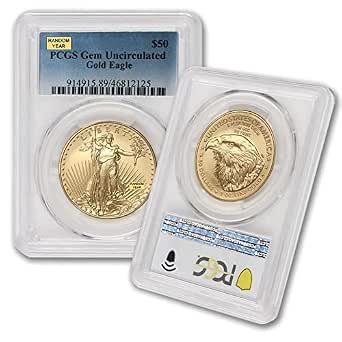
American Gold Eagle 1 oz Coin, Random Year, PCGS Gem Uncirculated
This is the more flexible Gold Eagle choice for investors who want one troy ounce of gold and PCGS Gem Uncirculated grading but do not need a specific date. Its year may range from 1986 to the present, and the coin can be Type 1 or Type 2, so the listing gives less control than the 2026-W First Strike Gold Eagle. Both Eagles contain 91.67% gold, while the Gold Buffalo offers 99.99% purity at the same one-ounce gold weight. The random-year format may suit buyers who rank bullion content and a graded Eagle above date selection, but it limits set-building and certainty about design type. A stock image is not a promise of the exact coin received. I’d choose the 2026-W option instead when a known year and First Strike designation are part of the goal.
Pros:- Contains 1 troy ounce of gold.
- PCGS Gem Uncirculated grading provides third-party condition assessment.
- American Gold Eagle format offers a U.S. bullion alternative to the 24K Gold Buffalo.
- Year range extends from 1986 to the present.
Cons:- Year is random, so a specific date cannot be selected.
- Coin type may be Type 1 or Type 2.
- Stock photo may differ from the coin received.
Best for: Investors who want a PCGS-graded, one-ounce American Gold Eagle and are indifferent to its year and Type 1 or Type 2 design.
Not ideal for: Buyers building a date-specific collection or seeking a guaranteed coin type, current-year issue, or First Strike certification.
- Metal:Gold
- Gold purity:91.67% (0.9167 fine)
- Precious metal weight:1 troy ounce
- Diameter:32.7 mm
- Thickness:2.87 mm
- Denomination:$50
- Grade:Gem Uncirculated
- Grading service:PCGS
- Year and type:Random year, 1986 to present; Type 1 or Type 2
Our verdict“Choose this random-year Eagle if you want a PCGS-graded one-ounce Gold Eagle and are willing to leave the date and type to chance.”

How We Picked
I compared these 14 listings by how clearly they serve an investor’s main goal: acquiring identifiable gold content in a format that can be assessed and resold. The ranking favors stated gold weight and purity, familiar bullion programs, and standard formats over jewelry settings, scarce or historic issues, and grading labels that may add collector appeal without changing the underlying gold content. I also weighed divisibility: fractional pieces can help buyers make smaller purchases, but small units may carry more premium per ounce.
The top positions go to products with the clearest bullion role and the fewest extra variables. The Maple Leaf ranks ahead for its fine-gold specification and uncomplicated 1-ounce format; the Eagle and Krugerrand remain strong alternatives for buyers who value their established coin programs. Graded and special-edition products rank lower for a bullion-first strategy, while pendants and the small bar are included as adjacent choices rather than direct substitutes for standard investment coins. Actual dealer buyback terms, premiums, and availability can vary, so I treat those as questions buyers should verify rather than fixed product advantages.
| gold bullion coins for investor | Grade |
|---|---|
| Canadian Gold Maple Leaf Coin | — |
| American Gold Eagle 1/10 oz Bu | — |
| 2025-W American Gold Buffalo $ | MS-70 |
| Solid 22K Yellow Gold 1 oz Ame | — |
| Perth Mint 1 Gram Gold Bar wit | — |
| 2026 American Gold Eagle 1/10 | Mint State |
| Canadian 1 Gram .9999 Gold Map | — |
| 24K Yellow Gold 50 Yuan Panda | — |
| French Gold Rooster 20 Francs | — |
| South African Gold Krugerrand | Gem Uncirculated |
| 2026-W 1 oz American Gold Eagl | Gem Uncirculated (GemUNC) |
| American Gold Buffalo 1 oz Gem | GEMUNC |
| 1947 Mexican 50 Pesos Gold Coi | Gem Uncirculated |
| American Gold Eagle 1 oz Coin | Gem Uncirculated |
Factors to Consider When Choosing Gold Bullion Coins For Investors
Choosing gold for investing is not only a matter of selecting the coin with the highest purity. I would first separate the value of its gold from any added cost tied to size, grading, design, or jewelry, then check whether the format fits how I plan to buy and sell.
Separate Gold Content From Product Premium
A coin’s stated weight tells you how much gold it contains, while the amount you pay also reflects fabrication, distribution, and product-specific demand. Compare offers using the same unit of fine gold rather than comparing a 1-gram piece directly with a 1-ounce coin. Small units can be convenient when buying incrementally, but that convenience may come with a larger premium per ounce. A graded coin or pendant can add further costs that may not be recovered when reselling for bullion value. Ask a seller how the item is priced relative to its gold content and what documentation supports the description. Treat any premium as a deliberate choice, not proof that the product will perform better as an investment.
Match Purity and Alloy to Your Priorities
Fine-gold coins such as the Maple Leaf and Buffalo differ from 22-karat coins such as the American Gold Eagle and Krugerrand. Alloy metals make a coin more durable, while a 24-karat coin offers a higher proportion of gold by weight. Compare the stated fine-gold content, not just the total coin weight or karat label. A 1-ounce coin can contain one troy ounce of gold even if the coin itself weighs more because of alloy. Buyers sometimes assume that higher purity automatically means easier resale; market familiarity and dealer policies can matter just as much. Check how local buyers handle each coin type before making purity the sole deciding factor.
Choose a Size That Fits Your Selling Plan
Fractional coins let an investor sell or allocate smaller amounts of gold without dividing a full-ounce holding. That flexibility can help with staged purchases, gifting, or a future need to sell only part of a position. The tradeoff is that smaller pieces often cost more per ounce than larger standard coins. Think about whether you expect to sell the full holding at once or value the ability to sell in increments. Avoid buying several tiny units just because each purchase feels more manageable; compare their combined gold content and premiums with a larger coin. The right size is the one that fits both your purchase budget and your likely resale decisions.
Treat Grading as a Collectible Feature, Not a Guarantee
Professional grading can describe a coin’s condition and may matter to collectors, but a high grade does not guarantee a better bullion resale outcome. Labels such as First Strike or First Day of Issue are designations attached to a coin’s submission or release context, not additional gold. For an investor focused on metal value, the grading fee and any added premium may be hard to justify. Before paying extra, ask whether likely buyers in your market pay separately for the grade or primarily value the coin by weight and type. Compare the graded listing with a standard ungraded bullion coin of similar gold content. Choose graded examples when the collector angle is part of your goal, not as a substitute for evaluating the bullion economics.
Check Whether the Item Is Actually a Bullion Coin
A coin pendant is a jewelry product as well as a gold item, and its setting or design can make its cost difficult to compare with a standard bullion coin. A small gold bar is bullion but is not a coin, so it may have different recognition and resale procedures. Historic francs and pesos can carry numismatic interest alongside their gold content, which introduces questions about authenticity, condition, and buyer demand. Read the full product description to distinguish coin weight from total jewelry weight and fine-gold content. For older or unusual pieces, confirm the issuer, date or restrike status, grading details, and seller documentation. Keep standard bullion and collectible or jewelry purchases in separate parts of your decision so their costs are easier to judge.
Plan for Storage, Verification, and Resale
Before buying, decide how you will store the coins and how you would verify or sell them later. Original packaging, assay cards, and grading holders can help preserve identification, but packaging alone does not replace checking the seller’s reputation or the product’s specifications. Ask prospective dealers which formats they accept and whether they require intact packaging or particular documentation. Consider whether you can store loose coins safely without scratching or mixing them with pieces of different types. Keep purchase records and product details together, especially for random-year, historic, or graded items. A coin that is easy for you to identify and present to a buyer may be more practical than one selected only for an unusual label.
Frequently Asked Questions
Should I choose a 24-karat Maple Leaf or a 22-karat American Gold Eagle?
I would compare the fine-gold content, purchase premium, and the dealers you expect to use rather than choosing by purity alone. The Maple Leaf’s .9999-fine specification makes it a direct fit for buyers who want a high-purity bullion coin. The Eagle contains alloy metals, which contribute to durability and form part of a widely recognized U.S. coin format. Both can suit bullion investors, but local resale preferences may affect which is more convenient. Check current product specifications and ask a prospective buyer how each coin is valued before deciding.
Are 1/10-ounce gold coins a sensible way to start investing?
They can make smaller, staged purchases possible and let you sell a portion of your holdings without parting with a full ounce. The tradeoff is that fractional coins can carry more premium per ounce than larger coins. I would compare the total cost of several fractional pieces with a standard coin containing the same gold weight. Also check whether the dealer’s buyback terms differ by size. A fractional coin makes sense when flexibility matters enough to justify its added unit cost.
Does a PCGS or NGC grade make a bullion coin a better investment?
A grade records a professional assessment of condition, but it does not add gold or guarantee a higher resale value. Graded examples may appeal to collectors, while bullion-focused buyers may concentrate on coin type and gold content. Special labels such as First Strike or First Day of Issue also do not change the amount of metal in the coin. Before paying a grading premium, ask likely resale buyers whether they pay extra for that grade or designation. If your goal is primarily exposure to gold, a standard bullion issue may offer a simpler comparison.
How should I compare a gold coin pendant with a bullion coin?
Start by separating the pendant’s fine-gold content from the weight and cost of its setting. Jewelry may include design and manufacturing costs that a bullion buyer will not necessarily recover when selling. Confirm whether the coin itself is genuine bullion, whether it has been altered for mounting, and how the seller states its gold weight. Compare its cost per unit of fine gold with a standard coin, then check how a dealer would buy it back. A pendant fits buyers who also want wearable jewelry; it is usually less straightforward for a bullion-only strategy.
Is a historic gold coin such as a 20 Francs Rooster or 50 Pesos a good substitute for modern bullion?
It can hold gold value, but historic and restrike coins add questions that standard modern bullion may not. Buyers need to distinguish gold content from any collectible premium and verify the coin’s authenticity, condition, and stated restrike status. Resale interest can depend on local familiarity with that specific coin. I would request clear documentation and compare the seller’s terms with a widely recognized bullion coin of similar gold content. Choose a historic issue when its additional character or collector market matters to you, not simply because it is described as gold.
Conclusion
For a bullion-first buyer, I rank the Canadian Gold Maple Leaf as the best overall because its 1-ounce, .9999-fine format keeps the decision focused on gold content. The best value-oriented choice is a standard, ungraded 1-ounce coin such as the random-year American Gold Buffalo, provided its premium and resale terms compare favorably with other options available to you. For beginners who prefer smaller purchases, the 1/10-ounce American Gold Eagle offers a familiar fractional format, though its per-ounce cost deserves close comparison. The best premium pick for a collector-investor is the graded 2025-W Buffalo or a graded Eagle, but I would pay extra only if grading and collector appeal matter beyond bullion value. For specific needs, consider the Krugerrand for an established alternative to U.S. and Canadian coins, the Perth Mint bar for a compact non-coin format, and the pendants only if wearable jewelry is part of the goal. Before choosing, compare fine-gold content, seller terms, and the premium you are willing to accept.