
TL;DR

Get home office essentials delivered free with Prime
- Fast, free delivery on millions of items
- Prime Video, Amazon Music and more included
- Member-only deals all year
Anthropic’s $65 billion Series H isn’t just a valuation milestone. It’s a strategic move to lock in massive compute capacity from chipmakers and cloud giants, highlighting the industry’s bottleneck: hardware and infrastructure. Revenue growth and hardware commitments reveal a new era of AI scaling.
When a startup hits a $965 billion valuation, you think about market hype and headlines. But behind the numbers, there’s a deeper story. Anthropic’s latest funding round isn’t just a valuation jump — it’s a clear signal that the race is shifting from pure AI research to the hardware and infrastructure that power these models.
This isn’t about just raising dollars; it’s about locking in the physical capacity needed to train and run the next wave of frontier AI models. Think of it as a strategic arms race for compute, with chipmakers and cloud giants playing a starring role. If you want to understand where AI is headed, this round is the clearest sign yet that hardware constraints are the new bottleneck.
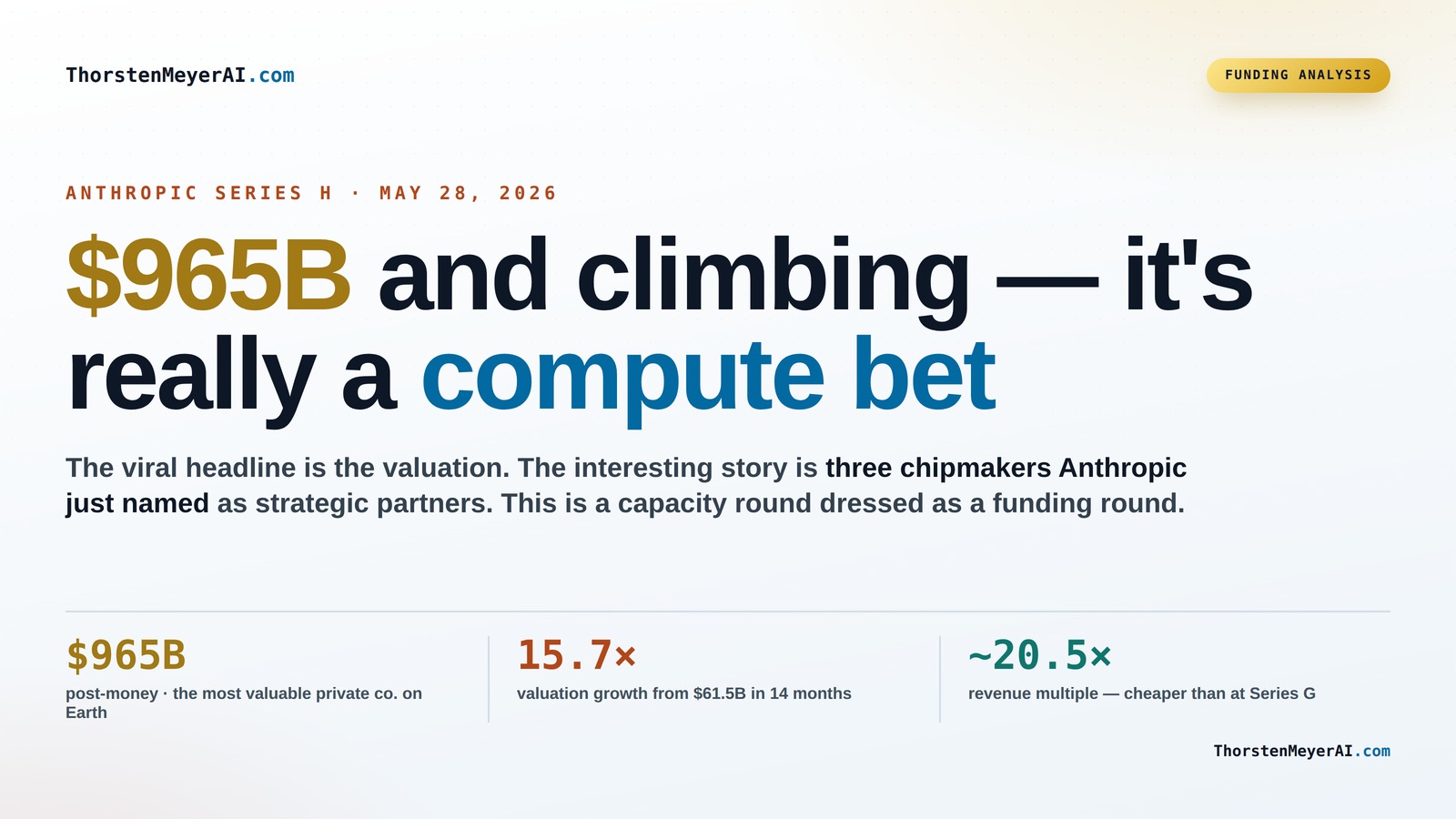
$965B and climbing — it’s really a compute bet
The viral headline is the valuation. The interesting story is in the press release’s middle paragraphs — and in three chipmakers Anthropic just named as strategic partners. This is a capacity round dressed as a funding round.
The numbers nobody can quite parse in sequence
Read together they describe a trajectory with no precedent in enterprise software. Read individually, each looks like a typo.
From $61.5B to $965B in fourteen months
Salesforce took roughly two decades to reach revenue numbers Anthropic just blew past. The sequence below is the part most coverage skips — it’s not the size, it’s the shape.
Anthropic’s valuation ladder · Mar 2025 → May 2026
Five rounds, fourteen months. Bar height is the valuation; the climb itself is the story. Tap any milestone for context.
The multiple actually got cheaper
Bubbles look like multiples expanding while revenue lags. Anthropic’s pattern is the inverse — the valuation tripled, but revenue grew faster, and the multiple compressed.
Revenue-to-valuation multiple · Series G → Series H
Same company, three months apart. The denominator (revenue) is outrunning the numerator (valuation) — exactly the opposite of what a bubble narrative predicts.
10+ gigawatts and three chipmakers
When you name Micron, Samsung & SK hynix alongside your equity backers, you’re saying the binding constraint isn’t demand or model quality — it’s the physical supply of memory chips. The Series H is a capacity round.
Compute commitments backing Anthropic’s capacity bet
$200B+ in announced compute spend across multi-year contracts. The $65B Series H raise has to be read against that bill, not against operating losses.
A genuinely durable bet — or a structural exposure?
Both readings can be true at once. The answer arrives over the next 18–24 months as the gigawatts come online and either fill with paying demand or don’t.
Revenue growth has no precedent in B2B software ($1B → $47B in 17 months). The multiple is compressing, not expanding. Claude is the only frontier model on all 3 major clouds. Enterprise AI spend share went from ~10% to >65% in a year. Compute commitments are tied to specific contracts with capacity dates.
20× revenue is not cheap by any historical software-investing standard. Revenue is reported gross of cloud-reseller pass-throughs, which inflates the top line. Profitability is 2 years out. Amodei’s own warning: a 12-month delay in AI progress “would make him bankrupt” — the compute commitments are a structural exposure to demand persistence.
The valuation race — and the IPO context
Anthropic shipped Opus 4.8 the same morning as Series H — not a coincidence. One week after OpenAI filed confidentially for IPO. The late-2026 frame is set: two frontier AI companies racing to public markets, each pitching durability.
Key Takeaways
- The $965 billion valuation signals a focus on infrastructure, not just market hype.
- Over $15 billion of the round is committed to chipmakers and cloud capacity, emphasizing hardware dependency.
- Revenue growth is outpacing valuation, indicating a maturing market that values real business traction.
- Strategic partnerships with chipmakers and hyperscalers show infrastructure is the new battleground.
- AI’s scaling bottleneck now lies in hardware supply chains, not just model development.
As an affiliate, we earn on qualifying purchases.
Why the $965B valuation is just the tip of the iceberg
The headline makes your jaw drop — $965 billion. But the real story is what that number represents. Anthropic’s valuation soared from $61.5 billion in March 2025 to nearly a trillion dollars in just over a year. That’s a 15.7× jump. Yet, the growth in revenue is even more staggering.
They’re now pulling in a run-rate of $47 billion — more than quadrupling their revenue in just a few months. This rapid growth pushes the valuation multiple down, meaning the company is actually becoming cheaper relative to revenue, not more expensive. It’s a sign that market enthusiasm is catching up with real-world traction.
Why does this matter? Because it signals that investors are starting to value Anthropic not just on hype but on tangible business results. The compression of valuation multiples amidst rapid revenue growth reflects a maturing market where operational performance and future potential are increasingly prioritized over speculative valuations. This shift has profound implications: it suggests that AI companies will need to demonstrate real revenue streams and infrastructure readiness to sustain high valuations, emphasizing the importance of scalable, hardware-backed growth rather than just model innovation.

As an affiliate, we earn on qualifying purchases.
This isn’t just a funding round — it’s a capacity war
The middle paragraphs of the press release reveal the truth: this is a *capacity round*. Over $15 billion of the funds come from committed investments by hyperscalers like Amazon, Microsoft, and Nvidia. These aren’t just investors; they’re partners supplying the hardware and cloud resources.
Anthropic named chipmakers — Micron, Samsung, SK hynix — as “strategic infrastructure partners.” That’s a clear signal: the company is betting heavily on memory and storage chips to fuel its growth. It’s not just about money; it’s about access to the physical components that power AI training and inference at massive scale.
This strategic focus on capacity reflects an understanding that AI’s future depends on the ability to rapidly deploy and scale hardware infrastructure. These commitments are essentially securing a pipeline of essential components—like high-speed memory and specialized chips—that determine how quickly frontier models can be trained and deployed. The tradeoff? Companies must balance short-term financial gains with long-term investments in infrastructure, risking capital if hardware supply chains face disruptions or if demand outpaces supply. But the payoff is gaining a crucial edge in the AI race, where hardware availability can mean the difference between leading or lagging behind in model scaling.

As an affiliate, we earn on qualifying purchases.
How much of this is hardware vs. cash?
Of the $65 billion raised, more than $15 billion is from pre-committed investments linked to cloud and hardware. Amazon alone committed $5 billion. That’s a huge chunk dedicated to hardware, not just equity funding. So, what does this mean for Anthropic?
It’s a strategic move: they’re securing the physical infrastructure to scale models without waiting for supply chains to catch up. This kind of funding blurs the line between raising capital and locking in capacity — a sign that the real game now revolves around hardware availability.
This approach reflects a recognition that hardware shortages and supply chain bottlenecks are among the most significant barriers to AI progress. By securing hardware commitments upfront, Anthropic aims to mitigate risks associated with supply chain disruptions, which could delay or limit their ability to scale models effectively. It also signals a shift in industry strategy: instead of waiting for hardware to become available, AI companies are proactively investing in infrastructure as a core part of their growth plan, accepting that access to physical resources is now a strategic asset and a competitive differentiator.

As an affiliate, we earn on qualifying purchases.
The compute bottleneck is the new oil
Compute power has become the defining factor of AI progress — not just research talent or data. Anthropic’s rapid revenue growth and infrastructure commitments highlight a fundamental truth: scaling frontier models depends on access to chips, memory, and cloud capacity.
Imagine trying to train a trillion-parameter model. You need thousands of GPUs, terabytes of memory, and a network that can handle petabytes of data. The supply chain for these components is now the bottleneck — and Anthropic’s round aims to bypass that.
This is exactly why chipmakers like Micron and Samsung are key players. Their capacity and speed determine how quickly models can grow from hundreds of billions of parameters to trillions. Learn more about the compute-driven future. Without sufficient hardware supply, progress stalls—even with the best algorithms and data. Therefore, controlling and expanding hardware capacity isn’t just a technical concern; it’s a strategic imperative for AI leadership. The implications are clear: AI’s future growth depends on the ability to rapidly scale infrastructure, making investments in hardware supply chains as critical as innovations in model architecture. Read more about AI infrastructure.

What does the investor list tell us?
The investor roster reads like a who’s who of industry giants: Sequoia, Andreessen Horowitz, Blackstone, Fidelity. But more telling is the strategic nature of their commitments. Fifteen billion dollars of the round is hyperscaler money, including $5 billion from Amazon.
This isn’t ordinary VC funding. It’s a coordinated effort to secure the physical resources needed for the next wave of AI models. These giants are betting on hardware and cloud infrastructure as much as on the software itself. Their involvement signifies a recognition that without robust infrastructure, AI development hits a hard cap—no matter how advanced the algorithms are. The strategic investments in hardware and capacity are thus not just financial; they are infrastructure insurance policies, ensuring that AI companies can meet future demands without being constrained by physical resource shortages.

Revenue growth vs. valuation — what’s really happening?
Anthropic’s revenue exploded from $9 billion at the end of 2025 to a projected $47 billion in mid-2026. That’s a 5.4× increase in just four months. Despite the valuation tripling, the multiple actually shrank from about 27× to roughly 20.5× revenue.
This pattern flips the usual bubble story. Instead of multiple expansion, we see multiple contraction paired with rapid revenue growth. It’s a sign that investors are beginning to value the actual business more than hype. This shift indicates a maturing industry where operational metrics, revenue streams, and infrastructure readiness are becoming more critical than speculative valuations based solely on potential.
The implication? Future valuations will likely depend more on demonstrated growth and capacity to scale than on hype cycles. This transition could lead to a more sustainable AI investment environment, where infrastructure investments directly translate into valuation stability and growth.

Comparing Anthropic and OpenAI: What’s the real story?
At $852 billion, OpenAI’s valuation in March 2026 was roughly 65× its trailing revenue of about $13 billion. In contrast, Anthropic at $965 billion and $47 billion in revenue trades at roughly 20.5×. That’s a stark difference.
It turns out Anthropic is larger, growing faster, and trading at a lower multiple. This suggests the market is valuing infrastructure and revenue potential over hype. It’s a sign that AI giants are shifting focus from just models to the hardware that runs them, emphasizing the strategic importance of physical resources in sustaining growth and competitive advantage.
As AI continues to mature, the market appears to be rewarding companies that demonstrate tangible infrastructure investments and operational scalability rather than those relying solely on model innovation. This trend underscores a crucial industry pivot: the future of AI success will depend heavily on physical capacity and supply chain resilience, not just algorithmic breakthroughs.
Frequently Asked Questions
Why is the headline valuation so high?
The valuation reflects not just market hype but a strategic bet on AI infrastructure, cloud capacity, and hardware supply chains that will power future growth.How much of the $65B is actually new money versus committed infrastructure spending?
More than $15 billion is from pre-committed investments linked to hardware and cloud infrastructure, especially from hyperscalers like Amazon and Microsoft.Why is this called a compute deal instead of a normal funding round?
Because a significant portion of the funds is tied directly to hardware, chipmakers, and cloud capacity commitments, making it as much about physical infrastructure as about company valuation.What does $47B run-rate revenue really mean?
It indicates rapid business traction, with revenue expected to surpass $50 billion by mid-2026. This level of revenue justifies the valuation and signals a maturing market.How does Anthropic’s valuation compare with OpenAI’s?
Anthropic’s valuation is higher, but its revenue multiple is significantly lower, reflecting a shift toward valuing infrastructure and real growth over hype-driven valuations.Conclusion
This funding round isn’t just a celebration of valuation — it’s a clear message: the future of AI depends on hardware. Companies like Anthropic are investing now to outpace the physical limits of today’s infrastructure.
If you want to see where AI is headed, watch the hardware supply chains — because the real race is for the chips, memory, and cloud capacity that will define AI’s next chapter. The question isn’t how big models get, but how fast the world can supply the power to run them.

Halloween Picks
halloween
As an affiliate, we earn on qualifying purchases.