
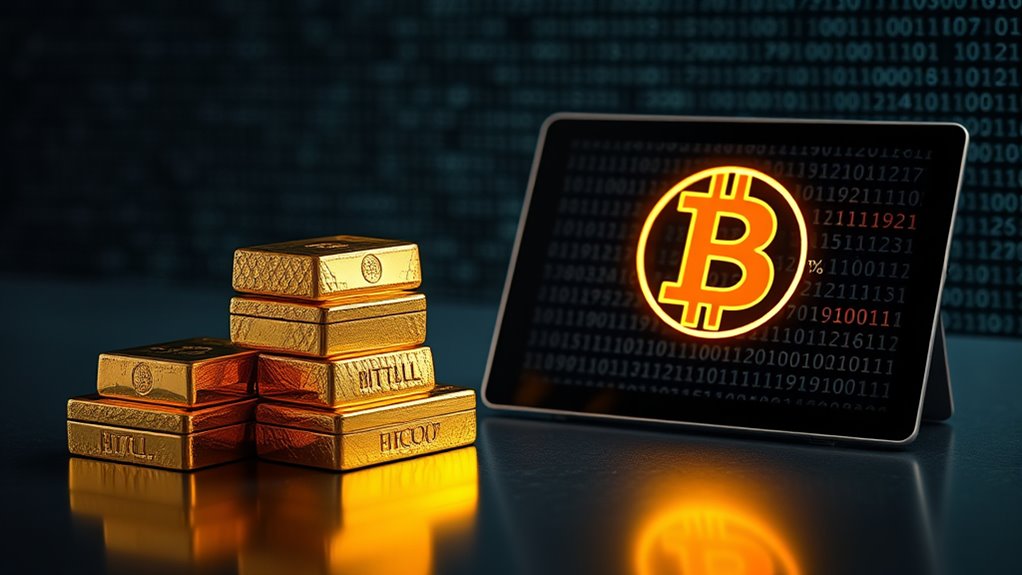
If you’re choosing between Bitcoin and gold for your retirement, consider their stability, growth potential, and risk. Gold has a proven, steady long-term track record and is less volatile, making it reliable for preservation. Bitcoin offers higher growth but with more short-term swings and uncertainty. Your decision depends on your risk appetite and investment goals. To better understand how each fits into your retirement plan, explore the details below.
Key Takeaways
- Gold offers proven stability and lower volatility, making it a safer choice for conservative, long-term retirement preservation.
- Bitcoin provides higher growth potential but with increased volatility and risk, suitable for investors with higher risk tolerance.
- Gold’s extensive regulatory backing and physical nature ensure consistent demand and resilience during economic downturns.
- Bitcoin’s digital portability and divisibility facilitate modern, global transactions, appealing to younger, tech-savvy investors.
- Diversifying with both assets can balance stability and growth, aligning with varied retirement goals and risk profiles.
Historical Performance and Returns

When comparing their historical performance, Bitcoin and gold reveal striking differences in growth and stability. Over the 2015–2025 period, Bitcoin’s price skyrocketed by about 39,600%, averaging around 75% annual returns. Gold, on the other hand, delivered roughly 160% over ten years, or about 10% annually. Bitcoin’s explosive growth makes it one of the most remarkable assets in financial history, but it’s also highly volatile, with sharp drops along the way. Gold’s performance has been more stable, offering consistent, moderate gains with less short-term fluctuation. Both assets hit new all-time highs in 2025, but Bitcoin’s recent outperformance is unmatched—though it comes with higher risk. Your choice depends on whether you prioritize growth or stability in your long-term strategy. Additionally, understanding the long-term stability of assets can help investors make better decisions for their retirement planning.
Market Size and Supply Dynamics

Gold’s long-standing status as a store of value is reflected in its massive global market capitalization, which stands at approximately $22 trillion. You’ll notice that gold’s supply is finite but not strictly limited, with new gold mined and recycled continuously, growing about 1.7% annually. In contrast, Bitcoin’s supply is capped at 21 million coins, with a predictable 3% annual increase until the cap is reached. The key differences include:
- Gold’s market cap is roughly 11 times larger than Bitcoin’s.
- Gold’s physical supply is finite but adaptable through mining and recycling.
- Bitcoin’s supply is strictly algorithmic and predictable.
- Gold’s long history of accumulation supports its dominance.
- Bitcoin’s divisibility and portability add unique supply advantages for digital assets.
These dynamics influence each asset’s scarcity and long-term potential as a store of value.
Risk and Price Volatility

Have you ever wondered how much the risk differs between Bitcoin and gold? Bitcoin’s price swings are intense, often moving more than four times as much as gold in short periods. Its Value-at-Risk (VaR) is nearly five times higher, meaning a $10,000 investment could lose about $1,382 weekly, compared to much less with gold. This high volatility can lead to significant short-term losses, making Bitcoin riskier for long-term retirement savings. Gold, on the other hand, offers stability, typically maintaining its value during crises. Here’s a quick comparison:
| Asset | Volatility | Typical Drawdowns |
|---|---|---|
| Bitcoin | 4.5x gold, 3x S&P 500 | Larger, sharper drops |
| Gold | Lower, stable | Smaller, gradual dips |
| S&P 500 | Moderate | Less severe |
Additionally, market stability plays a crucial role in determining the safest long-term store of value.
Underlying Demand and Use Cases

While Bitcoin relies solely on network adoption and technological trust, gold’s demand is driven by both physical and financial factors. You see, gold’s appeal isn’t just as an investment; it’s rooted in cultural, industrial, and monetary uses. Its tangible nature guarantees consistent demand in various sectors, from jewelry to electronics. Meanwhile, Bitcoin’s demand stems from its decentralized, digital nature, primarily fueled by investor speculation and technological innovation. Additionally, gold’s holistic healing properties and historical significance contribute to its enduring value.
Institutional Adoption and Regulatory Environment

You’ll notice that institutional holdings in Bitcoin are increasing, but they still lag behind gold’s long-established role in the financial system. Regulatory clarity is improving but remains uncertain in many jurisdictions, which affects broader adoption. As markets mature, the contrast between Bitcoin’s evolving environment and gold’s stable regulatory framework becomes more evident. Additionally, the potential for Volkswagen Tuning to influence market perceptions of value highlights how technological and regulatory shifts can impact long-term asset stability.
Institutional Holdings Growth
Institutional adoption of Bitcoin has been steadily increasing as more organizations recognize its potential as a store of value and hedge against economic instability. This growth reflects a shift toward mainstream acceptance, driven by institutional investors, hedge funds, and large corporations diversifying their holdings. As confidence builds, you’ll notice several key developments:
- Major financial firms adding Bitcoin to balance sheets
- Increased participation in regulated futures markets
- Institutional-grade custody solutions emerging
- Growing interest from pension funds and endowments
- Expanded investment products like ETFs and trusts
These trends signal a maturing market, though regulatory clarity remains essential. While gold benefits from decades of institutional backing, Bitcoin’s rising institutional interest may accelerate its long-term legitimacy as a store of value, shaping its place in retirement portfolios. The cybersecurity vulnerabilities associated with digital assets highlight the importance of secure storage solutions as institutional interest continues to grow.
Regulatory Clarity Progress
Regulatory clarity has become a defining factor in the ongoing development of Bitcoin’s market acceptance. As governments work to establish clearer rules, institutional confidence is gradually increasing, encouraging more widespread adoption. Some countries are creating supportive frameworks, reducing uncertainty and legitimizing Bitcoin as a store of value. However, other jurisdictions remain cautious or impose restrictive policies, which can hinder growth. Compared to gold’s well-established and globally regulated market, Bitcoin still faces significant legal and regulatory hurdles. The evolving landscape means that future regulation could either strengthen Bitcoin’s position or create new barriers. The existing regulatory environment influences the long-term stability and acceptance of Bitcoin, making it essential to monitor regulatory developments when considering it as a retirement store of value.
Market Maturity Level
While Bitcoin’s market maturity continues to develop, its adoption by institutions and the regulatory landscape remain uneven and evolving. You’ll notice that gold benefits from a long-established, globally regulated market, with widespread institutional holdings and clear legal frameworks. In contrast, Bitcoin’s institutional backing is growing but still limited, with regulatory uncertainty creating barriers. Consider these points:
- Gold’s markets are mature, regulated, and deeply integrated into financial systems.
- Bitcoin’s adoption by institutions is expanding but faces regulatory ambiguities.
- Gold’s status as a reserve asset is reinforced by centuries of acceptance.
- Bitcoin’s decentralized nature raises questions about legal recognition and oversight.
- Regulatory developments can profoundly influence Bitcoin’s market stability and future growth.
- Additionally, trustworthiness of brand and transparent sourcing are crucial factors influencing the perception of assets as reliable stores of value.
Understanding this uneven landscape helps gauge each asset’s long-term reliability as a store of value.
Role as a Hedge Against Inflation
You want to protect your wealth from inflation, but which asset really works? Gold has a long history of maintaining value during inflationary periods, while Bitcoin’s recent price increases suggest it could serve as an effective hedge too. Understanding their long-term effectiveness helps you decide which fits your strategy best. Additionally, crochet styles for locs demonstrate how versatile and customizable these assets can be, reflecting the importance of adaptability in your investment approach.
Inflation Resistance Evidence
Gold has long been regarded as a reliable hedge against inflation, thanks to its historical ability to preserve value during currency debasement. Its price tends to rise when fiat currencies weaken, maintaining purchasing power over time. Evidence shows that during inflationary periods, gold often outperforms other assets, reaffirming its role as a safe haven.
- Gold’s value increases as inflation rises, acting as a real asset.
- Historical data links gold prices with inflation rates, especially during hyperinflation.
- Gold’s supply is limited, preventing excessive dilution during economic crises.
- Its long-standing market presence supports stability amid inflation shocks.
- Gold’s demand from central banks and industrial sectors reinforces its resilience in inflationary environments.
Long-Term Hedge Effectiveness
Over the long term, gold has proven to be a reliable hedge against inflation because its value tends to rise when fiat currencies weaken. Its centuries-old history of maintaining purchasing power during economic downturns and currency devaluations demonstrates its resilience. Gold’s stable supply, physical demand, and widespread acceptance help it preserve value over decades. While its returns are moderate—around 10% annually—its consistency makes it a dependable component in a retirement portfolio. Bitcoin, with its limited supply and rapid growth, offers potential as a new inflation hedge, but its short track record and volatility make it less predictable. Diversifying with both assets can balance stability with growth, but gold’s established long-term hedge effectiveness remains unmatched for conservative, retirement-focused investors.
Liquidity, Divisibility, and Portability

Liquidity, divisibility, and portability are key factors that influence how easily an asset can be used, exchanged, or transferred. Gold, while historically valued, is less liquid and portable due to its physical nature—it requires secure storage and involves more complex transactions. In contrast, Bitcoin excels in these areas, offering near-instant transfers and high divisibility. You can:
- Transfer Bitcoin across borders within minutes
- Divide Bitcoin into tiny units called satoshis
- Store Bitcoin digitally, reducing physical security concerns
- Trade 24/7 without market hours
- Use digital wallets for seamless transactions
- Additionally, diversifying investments can help mitigate risks associated with asset volatility.
Gold’s physical form limits quick exchanges, especially internationally. Bitcoin’s digital infrastructure makes it highly adaptable for modern financial needs, but its reliance on technology and internet access can be a downside.
Resilience During Economic Turmoil

During times of economic turmoil, gold has historically proven to be a reliable safe haven, maintaining its value when markets become turbulent. Its long-standing reputation as a stable asset means you can count on gold to preserve purchasing power during crises, such as recessions or currency devaluations. Gold’s physical nature and global acceptance contribute to its resilience, as it isn’t directly affected by market shocks or policy changes like stocks or fiat currencies. While gold’s value might fluctuate slightly in the short term, it tends to recover quickly and hold steady during economic stress. This stability makes gold a dependable component of a diversified retirement portfolio, especially when you need an asset that can weather unpredictable financial storms. Additionally, gold’s market stability has been recognized as a key factor in its role as a long-term store of value.
Suitability for Long-Term Retirement Portfolios

Choosing the right assets for your long-term retirement portfolio involves balancing growth potential with risk mitigation. Gold offers stability, with decades of proven resilience and steady returns around 10% annually. It’s a safer choice for conservative investors seeking reliable preservation of wealth. Bitcoin, however, presents explosive growth but comes with significant volatility, making it less suitable for high allocations. To contemplate their roles:
- Gold provides consistent, less volatile returns and acts as a safe haven.
- Bitcoin offers high growth potential but with increased risk of large swings.
- Diversifying with both assets balances stability and growth.
- Gold’s historical acceptance makes it more reliable for long-term preservation.
- Bitcoin’s digital nature adds flexibility but demands a higher risk tolerance.
Your allocation should reflect your risk appetite, investment horizon, and long-term goals.
Frequently Asked Questions
How Do Regulatory Changes Impact Bitcoin’s Long-Term Store of Value?
Regulatory changes can profoundly impact Bitcoin’s long-term value. If governments impose strict rules, bans, or heavy taxation, it could limit adoption and reduce its liquidity, causing price drops. Conversely, clear, supportive regulations may boost investor confidence and institutional participation, increasing stability and acceptance. You should stay informed about evolving policies, as they influence Bitcoin’s legitimacy, security, and potential for becoming a reliable long-term store of value.
Can Bitcoin’s Technology Infrastructure Support Widespread Adoption Over Decades?
Yes, Bitcoin’s technology infrastructure can support widespread adoption over decades. Its decentralized network, robust security protocols, and ongoing technological improvements guarantee resilience and scalability. You should consider that Bitcoin’s blockchain is designed to adapt and upgrade, enabling future innovations. While some risks remain, the foundational technology has proven its durability, making it capable of sustaining long-term growth and adoption as more individuals and institutions trust and integrate it into their financial systems.
How Does Inflation Affect Gold and Bitcoin Differently as Stores of Value?
You might think both assets handle inflation well, but they do so differently. Gold has a long history of maintaining its value during inflation, acting as a reliable hedge. Bitcoin, however, has a capped supply and digital scarcity that could protect against inflation in the long run, but its short track record makes its effectiveness less certain. Diversifying your holdings can help balance inflation protection with growth potential.
What Are the Tax Implications of Holding Bitcoin Versus Gold Long-Term?
You’ll find that holding Bitcoin often triggers capital gains taxes when you sell or trade, since it’s treated as property in many countries. Gold, on the other hand, may have different tax rules, like lower capital gains rates or exemptions, depending on your jurisdiction. Keep in mind, long-term gains on both assets can be taxed at favorable rates, but tax laws vary, so consulting a tax professional is wise before investing.
How Might Future Technological Developments Influence Bitcoin’s Scarcity and Value?
Future technological developments could reinforce Bitcoin’s scarcity by strengthening its network security, improving transaction efficiency, and enabling better storage solutions. Innovations like quantum-resistant algorithms might protect its integrity, while advances in blockchain technology could make it more accessible. These improvements could boost demand and confidence in Bitcoin’s fixed supply, potentially increasing its long-term value. However, technological risks remain, so staying informed and cautious helps you manage future uncertainties effectively.
Conclusion
While some worry about bitcoin’s volatility, its potential for higher long-term growth makes it a compelling store of value. Gold’s stability and long history are reassuring, but crypto’s innovative technology offers unique advantages. If you’re willing to embrace the risk, bitcoin could outperform gold over decades, providing a powerful retirement hedge. Don’t dismiss the future—consider how both assets might fit into your strategy for a more resilient, diversified retirement plan.