

When choosing between an IRA and a 401(k), you’ll find that taxes differ: IRAs offer more control and broader investment options, while 401(k)s often have higher contribution limits and potential employer matching. Withdrawals before age 59½ usually face penalties, but there are exceptions. 401(k)s are protected from most creditors, unlike IRAs which have limited legal safeguards. Understanding these key rules can help you optimize your retirement plans, and more details await if you keep exploring.
Key Takeaways
- 401(k)s have higher contribution limits ($23,500 in 2025) than IRAs ($7,000 in 2025), enabling more savings.
- IRAs offer broader investment options and control, while 401(k)s limit choices to employer-sponsored plans.
- Roth accounts (both IRAs and 401(k)s) allow tax-free qualified withdrawals; traditional versions tax-deferred upon withdrawal.
- 401(k)s are protected from most creditors under ERISA; IRAs have limited federal bankruptcy protection.
- RMDs are mandatory at age 73 for traditional IRAs and 401(k)s, but not for Roth IRAs during the account holder’s lifetime.
Tax Treatment of Contributions in IRAs and 401(k)s

The tax treatment of contributions in IRAs and 401(k)s determines how your retirement savings are taxed now and in the future. With a 401(k), your contributions are typically made with pre-tax dollars, which lowers your taxable income in the contribution year. You’ll pay taxes when you withdraw the money in retirement. In contrast, traditional IRA contributions may be tax-deductible depending on your income and whether you participate in a workplace plan; taxes are due upon withdrawal. Roth 401(k)s and Roth IRAs are funded with after-tax dollars, so qualified distributions are tax-free. Earnings in both accounts grow tax-deferred until you withdraw. This setup affects your current tax liability and how much you’ll owe when you retire, shaping your overall tax strategy.
Withdrawal Penalties and Exceptions

When you withdraw funds early from your IRA or 401(k), you’ll typically face a 10% penalty plus income tax, unless you qualify for specific exceptions. Certain situations, like disability or qualified education expenses, can let you avoid the penalty. Once you reach the required minimum distribution age, failing to take RMDs can result in steep penalties, emphasizing the importance of understanding these rules.
Early Withdrawal Penalties
Early withdrawals from retirement accounts often come with penalties, which serve to discourage taking funds before reaching retirement age. If you withdraw money before age 59½, you typically face a 10% early withdrawal penalty in addition to owing income tax on the amount withdrawn. This penalty applies to both IRAs and 401(k)s, though some exceptions may reduce or eliminate it, like disability or qualified medical expenses. Keep in mind, the penalty is designed to discourage premature use of retirement savings, so unless you qualify for an exception, you’ll pay extra. The penalty applies regardless of whether you’re withdrawing from traditional or Roth accounts, though Roth accounts might have different rules for qualified versus non-qualified distributions.
Qualified Exceptions Allowed
Although early withdrawal penalties typically apply to discourage accessing retirement funds prematurely, there are specific situations where you can withdraw without facing the 10% penalty. For example, if you become disabled, you can take distributions penalty-free. Qualified medical expenses exceeding 7.5% of your AGI also qualify. Other exceptions include a qualified first-time home purchase (up to $10,000), higher education costs, and substantial equal periodic payments under IRS rules. Additionally, if you face an IRS levy or are called to active military service, penalties may be waived. In IRAs, you can also withdraw for certain expenses without penalty if you’re a qualified educator or if the withdrawal qualifies for a qualified birth or adoption expense. Always verify specific rules to ensure your situation qualifies. Retirement account regulations can vary depending on your specific circumstances.
RMD Penalty Rules
Once you reach the required minimum distribution (RMD) age, generally 73, failing to withdraw the mandated amount can result in a significant penalty. The IRS imposes a 50% excise tax on the amount you should have taken but didn’t. However, there are exceptions and ways to avoid penalties.
- If you miss an RMD, you must notify the IRS and withdraw the amount promptly to reduce penalties.
- You might qualify for a waiver if the failure was due to reasonable error and you act quickly.
- RMDs can sometimes be delayed if you’re still working and not a key owner in your 401(k).
- Staying informed about special event planning and themed breakfast strategies can help you better understand compliance and planning considerations for retirement accounts.
Understanding these rules helps you avoid costly penalties and stay compliant with IRS regulations.
Required Minimum Distributions and Age Considerations
Required Minimum Distributions (RMDs) are the mandatory withdrawals you must start taking from traditional IRAs and 401(k)s once you reach a certain age, ensuring the government collects taxes on your retirement savings. For traditional accounts, RMDs typically begin at age 73, though rules may vary if you’re still employed and not a key plan owner. Roth IRAs, however, don’t require RMDs during your lifetime. You can delay distributions in a 401(k) if you’re still working and not a significant owner. If you don’t take your RMD on time, you face hefty penalties—usually 50% of the amount you should have withdrawn. Age considerations are vital because they determine when you must start withdrawing and how it impacts your taxes and estate planning.
Investment Choices and Control Over Assets

When it comes to investment choices, IRAs generally give you greater control over your assets than 401(k) plans. You can select from a broad range of investments, including stocks, bonds, mutual funds, and ETFs, without restrictions imposed by an employer’s plan. This flexibility allows you to tailor your portfolio to your specific goals. With IRAs, you also have the ability to switch investments easily and manage your assets without plan-specific rules. In contrast, 401(k)s often limit you to options provided by the employer’s administrator, which can restrict diversification and trading frequency.
- Choose from a wider array of investments in IRAs
- Make quick changes without plan restrictions
- Avoid limited options that could hinder your strategy
Employer Contributions and Their Impact on Savings

Have you considered how employer contributions can substantially boost your retirement savings? If you participate in a 401(k), your employer might offer matching or profit-sharing contributions, adding “free money” to your account. These contributions can considerably increase your total savings over time, especially when combined with your own investments. Additionally, understanding the best-rated anime movies can provide enjoyable entertainment during your leisure time. However, keep in mind that employer contributions are often subject to vesting schedules, meaning you might forfeit some or all of these funds if you leave before fully vesting. Unlike IRAs, which receive only your personal contributions, 401(k) plans leverage employer funds to grow your nest egg faster. Taking full advantage of employer contributions can make a meaningful difference in reaching your retirement goals.
Eligibility Requirements and Account Setup Procedures

Eligibility requirements and account setup procedures determine how easily you can start saving for retirement. For a 401(k), you need to be employed by a company that offers the plan, and you’ll usually sign up through your HR department. With IRAs, anyone with earned income can open an account independently, without employer involvement. Here’s what you should know:
- You may need to provide proof of income or employment for a 401(k) setup.
- IRAs require just a few documents and can be opened online or in person.
- Solo 401(k)s are available if you’re self-employed, requiring additional paperwork.
- IRS regulations allow for gold investments in IRAs, providing diversification options.
Getting started is straightforward once you meet the criteria, but the process varies depending on the plan type.
Asset Protection and Legal Safeguards

You should understand how your IRA and 401(k) assets are protected from creditors and legal claims. Federal laws, like ERISA, offer strong protections for 401(k) funds, while IRAs have limited bankruptcy shields. Knowing these safeguards helps you plan for financial security and potential risks. Additionally, emerging developments in crypto regulation frameworks may influence future asset protections and legal considerations for digital assets.
Legal Credit Protections
When it comes to legal credit protections, 401(k) plans generally offer stronger asset protection than IRAs due to federal laws like ERISA. ERISA shields most 401(k) assets from creditors, except in cases like IRS tax liens or specific legal judgments. IRAs, on the other hand, have limited federal protection outside bankruptcy, often up to around $1 million. Additionally, many states offer state-specific protections for IRAs that can provide further security.
Here’s what you should know:
- 401(k) assets are protected from most creditors, thanks to ERISA.
- IRAs provide some federal bankruptcy protection, but less beyond that.
- You can borrow from your 401(k) via plan loans, but IRAs don’t allow loans; withdrawals may have tax consequences or restrictions.
Understanding these protections helps you safeguard your retirement savings against creditors and legal claims.
Bankruptcy Asset Shields
Bankruptcy asset shields play a crucial role in safeguarding your retirement savings during financial crises. Your 401(k) benefits from federal protections under ERISA, shielding most of its assets from creditors, except in cases of IRS liens or certain legal judgments. IRAs, however, have limited federal protection—up to about $1 million in bankruptcy cases—making them more vulnerable outside of bankruptcy proceedings. This means your 401(k) is less likely to be seized by creditors if you face bankruptcy, whereas IRAs can be at higher risk unless specific state laws provide additional protection. While both accounts offer some security, understanding these distinctions helps you plan your retirement savings to be more resilient against legal claims during financial hardships. Additionally, awareness of self-watering planters and other innovative gardening solutions can help optimize outdoor spaces for sustainability and aesthetic appeal.
Contribution Limits and Catch-Up Provisions
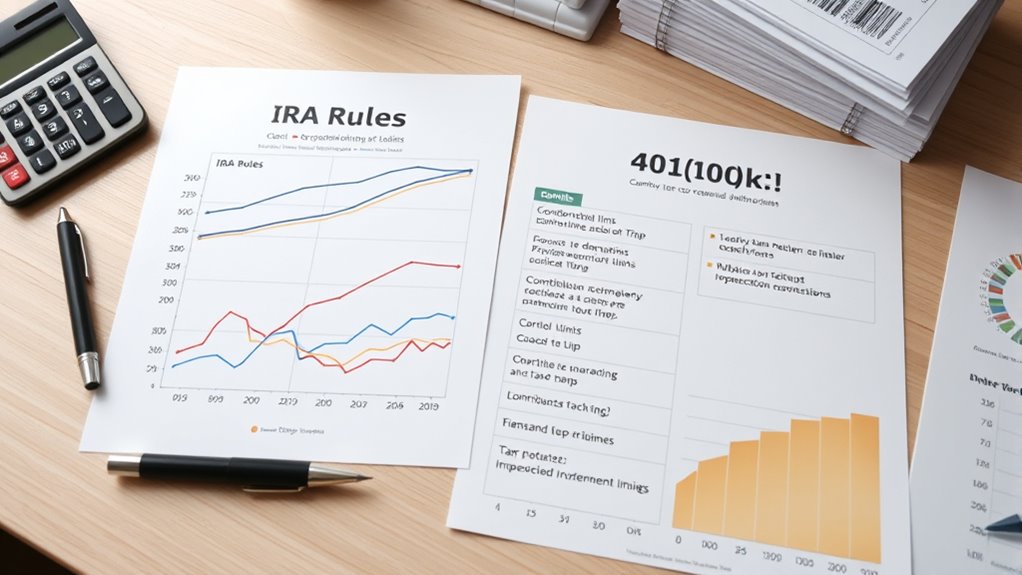
Contribution limits for retirement accounts set boundaries on how much you can save each year, with distinct caps for IRAs and 401(k)s. For 2025, you can contribute up to $7,000 to an IRA, with an extra $1,000 catch-up if you’re 50 or older. A 401(k) allows for higher contributions—up to $23,500, plus a $7,500 catch-up for those 50+, and even more for those aged 60-63 with super catch-up provisions. These limits help you maximize your savings, but only up to the annual cap. Additionally, understanding the contribution limits and how they vary between account types can help you plan more effectively for retirement.
Accessing Funds: Hardship Withdrawals and Loans

Accessing funds from your retirement accounts can be necessary in times of financial hardship, but the options differ between plans. 401(k) plans often allow you to take hardship withdrawals or loans, providing access to your savings without fully withdrawing or incurring penalties if you meet specific criteria. Hardship withdrawals from a 401(k) are limited to immediate and heavy financial needs, such as medical expenses or home purchases, and typically avoid the 10% early withdrawal penalty. Loans from a 401(k) let you borrow up to 50% of your vested balance, with repayment terms usually set within five years. IRAs don’t permit loans, and withdrawals are considered distributions, which may be taxed and penalized if taken before age 59½. Accessing funds should always be a last resort, given potential tax and penalty consequences. Regularly assessing your space and organization can help prevent financial emergencies and reduce the need for early withdrawals.
Differences in Tax-Free Growth and Qualified Distributions
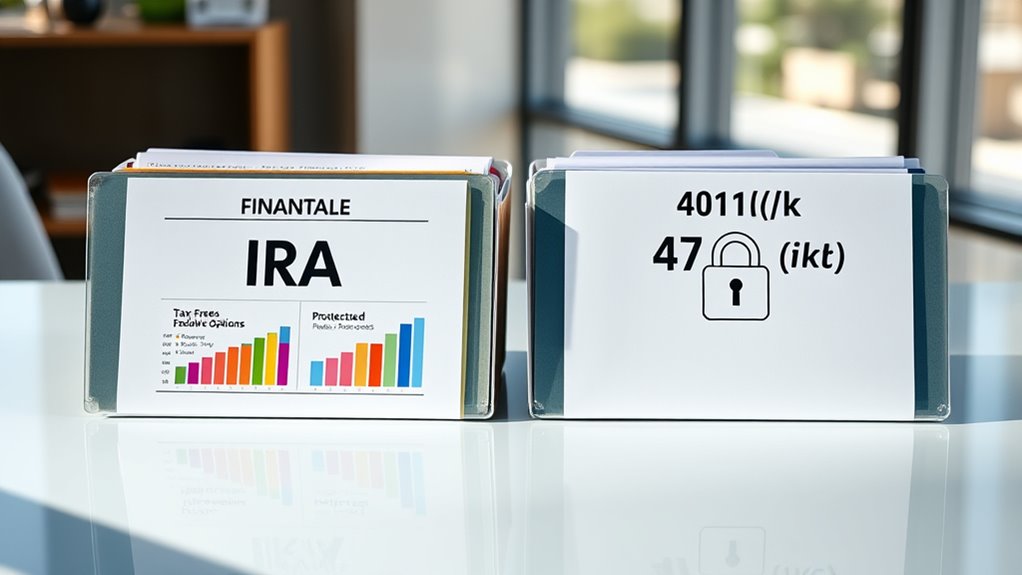
The key difference in tax treatment between 401(k)s and IRAs lies in how their growth and distributions are taxed. With a Roth 401(k) or Roth IRA, your contributions are made with after-tax dollars, so your earnings grow tax-free, and qualified withdrawals are also tax-free. Traditional options, however, grow tax-deferred, meaning you don’t pay taxes on earnings until you withdraw funds.
- Roth accounts offer tax-free growth and qualified distributions if you’re at least 59½ and have held the account five years.
- Traditional accounts grow tax-deferred, with taxes due upon withdrawal.
- Early withdrawals from traditional accounts may incur taxes and penalties, while Roths generally allow tax-free withdrawals of contributions anytime.
Frequently Asked Questions
Can I Convert a Traditional IRA to a Roth IRA?
Yes, you can convert a traditional IRA to a Roth IRA. You’ll need to pay taxes on the amount you convert, since traditional contributions are usually pre-tax. To do this, you’ll contact your IRA provider, specify the conversion, and make sure you understand the tax implications. Keep in mind, conversions can bump you into a higher tax bracket, so it’s wise to consult a tax professional before proceeding.
How Does Inheritance Affect IRA and 401(K) Beneficiaries?
When you inherit an IRA or 401(k), you step into a financial landscape filled with rules and options. You may need to take Required Minimum Distributions (RMDs), which can vary based on your relationship to the original owner. With IRAs, you often have more flexibility, especially if it’s a Roth. But in both cases, understanding the rules helps you navigate the inheritance smoothly and maximize your benefits.
Are There Penalties for Rolling Over Funds Between Accounts?
No, you typically won’t face penalties when rolling over funds between accounts if you do it correctly. You need to complete a direct rollover, where the money moves directly from one account to another, within the 60-day window if you receive a distribution. Failing to follow the proper process can result in taxes and penalties, so make sure to coordinate with your plan administrators or financial institutions to avoid issues.
What Are the Specific Rules for Taking Early Withdrawals?
Imagine pulling a sword from a stone—you can’t just do it anytime without consequences. Early withdrawals from IRAs or 401(k)s before age 59½ usually trigger a 10% penalty plus income tax. Exceptions exist, like disability or qualified medical expenses. Some plans allow hardship withdrawals without penalties, but they’re limited. Always check your plan’s rules first, because pulling funds early can substantially impact your retirement savings.
How Do State Laws Impact Asset Protection for Retirement Accounts?
State laws can considerably impact your retirement account protection. You might find that some states offer stronger creditor protections for IRAs and 401(k)s, especially in bankruptcy cases, while others provide limited safeguards. It’s essential to understand your state’s specific laws because they can determine whether your retirement funds are shielded from creditors or legal claims. Consult a local attorney or financial advisor to ensure your assets are adequately protected.
Conclusion
Ultimately, understanding how IRAs and 401(k)s differ helps you make smarter decisions—like recognizing that your choices today can unexpectedly influence your future financial security. Whether it’s the tax advantages, withdrawal rules, or protection measures, these details seem to align in ways that can either support or complicate your goals. So, as you plan ahead, remember that the right knowledge often comes at the perfect moment—just when you need it most.