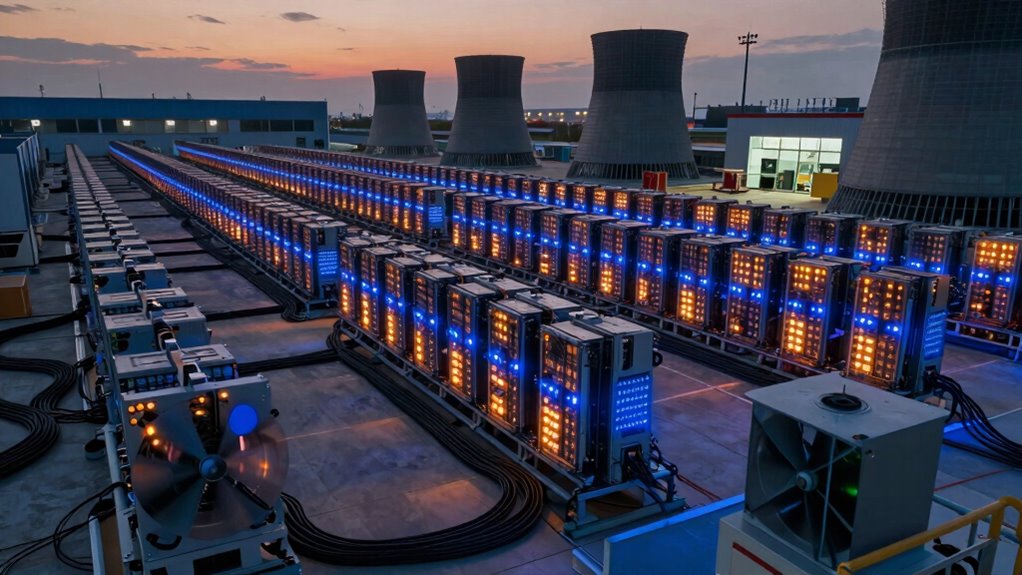

As hash rate growth increases, your risk profile for Bitcoin shifts toward greater network security and resilience, making it harder for malicious attacks to succeed. However, it can also lead to higher energy consumption and potential environmental concerns, which may trigger regulatory scrutiny and public backlash. Additionally, rising difficulty might squeeze out smaller miners, increasing centralization risks. These dynamics influence your exposure to both technological and ecological vulnerabilities; explore further to understand the full picture.
Key Takeaways
- Increased hash rate enhances network security but may lead to centralization if dominated by few large miners.
- Growing energy consumption raises environmental concerns, potentially impacting regulatory risk and market perception.
- Elevated hash rate improves resistance to attacks, reducing the risk of network manipulation or censorship.
- Rising difficulty and energy costs can push small miners out, increasing centralization and systemic risk.
- Changes in hash rate influence network stability and market confidence, affecting Bitcoin’s overall risk profile.
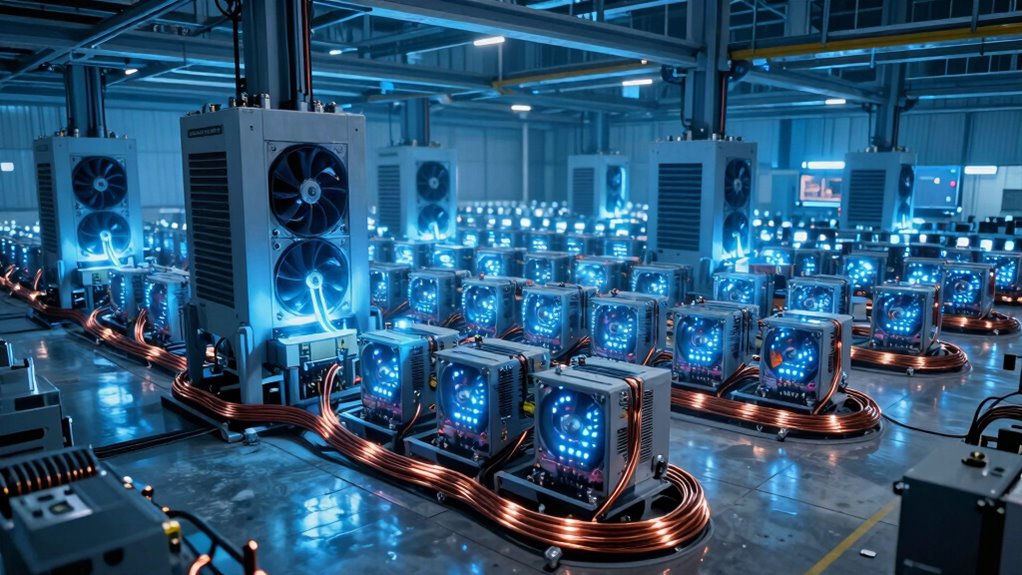
As the Bitcoin network’s hash rate continues to grow, it signals increasing computational power dedicated to securing the blockchain. This rise in hash rate can influence your risk exposure to Bitcoin in multiple ways. One key aspect is mining decentralization. When the hash rate climbs, it often reflects a more diverse and distributed set of miners, reducing the likelihood that a single entity or a small group controls a significant portion of the network’s power. This decentralization can make the network more resilient to attacks, giving you greater confidence in Bitcoin’s security. However, if the hash rate growth is driven by a few large players, centralization risks re-emerge, potentially threatening the network’s integrity and your investment’s safety. Hence, tracking who controls the hash rate is vital to understanding how the risk profile shifts as the network expands. Additionally, the increasing hash rate can lead to a more robust network, but only if the growth remains decentralized and distributed. An increase in hash rate can also impact the network stability, making it more resistant to potential disruptions. Moreover, fluctuations in the hash rate can influence the network’s overall security by affecting its ability to defend against malicious attacks. Furthermore, the rising energy consumption associated with higher hash rates raises concerns about the environmental sustainability of Bitcoin mining practices, especially if the energy used comes from non-renewable sources. As the hash rate increases, so does the total energy required to maintain the network. This growth can raise questions about the sustainability of Bitcoin mining, especially if the energy used comes from non-renewable sources. A higher energy footprint might attract regulatory scrutiny or lead to public backlash, which could impact Bitcoin’s value and your exposure. Conversely, if miners shift toward renewable energy, the environmental concerns lessen, but the increased energy use still signifies a significant resource commitment. The environmental and regulatory landscape can influence Bitcoin’s price stability, and by extension, your risk exposure. Furthermore, a rising hash rate can influence the network’s difficulty adjustment, making mining more challenging and potentially impacting miners’ profitability. This dynamic can lead to shifts in who can participate in mining activities, again affecting decentralization. When mining becomes more difficult and costly, smaller players might drop out, leaving larger, more resource-rich entities in control. This concentration can increase the risk of manipulation or censorship, which you need to contemplate when evaluating Bitcoin’s long-term viability.
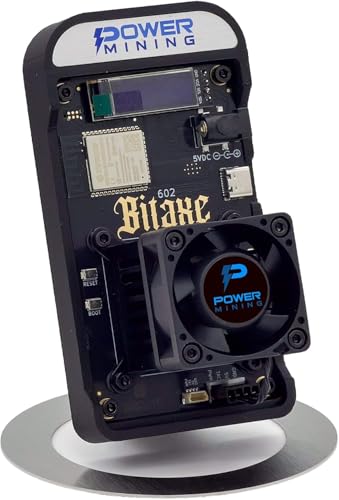
POWER MINING Bitaxe Gamma 602 ASIC Bitcoin Miner | 1.1 TH/s @ 18W | BM1370 Chip (Antminer S21 Pro) | Wi-Fi | USB-C | AxeOS | Open Source | Made in Europe | Incl. Power Supply & Stand
- Hashrate: 1.1 TH/s at 18W power
- Made in Europe: European design and manufacturing
- ASIC Chip: BM1370 chip from Antminer S21 Pro
As an affiliate, we earn on qualifying purchases.
As an affiliate, we earn on qualifying purchases.
Frequently Asked Questions
How Does Hash Rate Growth Impact Bitcoin’s Energy Consumption?
As the hash rate grows, Bitcoin’s energy consumption increases because more mining hardware is active, processing transactions. However, if miners prioritize energy efficiency, the overall energy use can be managed better. You’ll notice that advancements in mining hardware improve efficiency, reducing energy demands per unit of hashing power. So, while higher hash rates can mean more energy use, better energy efficiency in mining hardware helps mitigate environmental impact.
Can Increasing Hash Rate Lead to Centralization Risks?
Imagine a bustling city skyline — as the hash rate climbs, mining can become a towering skyscraper, risking centralization. Increased hash rate may concentrate power among large mining pools, threatening decentralization. This shift impacts energy efficiency, as bigger operations often use less efficient, high-energy hardware. You should watch for these trends, because centralization risks could undermine Bitcoin’s core value of distributed trust and security.
What Are the Geopolitical Implications of Hash Rate Shifts?
You should consider that shifts in hash rate can impact geopolitical stability, especially if mining power concentrates in specific regions. Changes in mining regulations or conflicts can disrupt the network, making it more vulnerable. As a result, you might see increased influence from governments, affecting decentralization. Staying aware of where hash rates shift helps you understand potential geopolitical risks and how regulatory environments can influence Bitcoin’s resilience.
How Does Hash Rate Growth Influence Bitcoin’s Transaction Speed?
When the hash rate grows, mining difficulty increases, which can slow down transaction processing times. However, a higher hash rate also boosts network security, making it more resilient against attacks. As a result, while transaction speed might experience slight delays during rapid hash rate increases, overall, the network remains stable and secure, encouraging user confidence and long-term growth in Bitcoin’s ecosystem.
Is There a Correlation Between Hash Rate and Bitcoin Price Volatility?
You’ll find that higher hash rates often correlate with reduced Bitcoin price volatility because increased mining security boosts network stability. When more miners participate, the network becomes more resilient against attacks and sudden swings, making the asset less prone to sharp price changes. So, as hash rate grows, you can expect Bitcoin’s price to become somewhat steadier, reflecting improved network security and overall stability.

Off-Grid Bitcoin Mining: Renewable Energy Solutions
As an affiliate, we earn on qualifying purchases.
As an affiliate, we earn on qualifying purchases.
Conclusion
As you watch the hash rate grow, remember it’s a key indicator of Bitcoin’s security and stability. With the hash rate increasing by over 200% since 2020, your exposure’s risk profile shifts—making the network more resilient but also more interconnected with global energy markets. Staying informed means you can better anticipate how these changes might impact your investments, helping you navigate the evolving landscape of Bitcoin with confidence.

Mining Rig Frame for 12GPU, Steel Open Air Miner Mining Frame Rig Case, Support to Dual Power Supply for Crypto Coin Currency Bitcoin ETH ETC ZEC Mining Tools – Frame Only, Fans & GPU is not Included
- GPU Slots: Supports 6, 8, or 12 GPUs
- Power Support: Supports dual ATX power supplies
- Material: Made of durable stainless steel
As an affiliate, we earn on qualifying purchases.
As an affiliate, we earn on qualifying purchases.

Bitmain Genuine Antminer Power Supply APW7 PSU 1800w 110v 220v New Model for S9 or L3+ or Z9 Mini or D3 ASICs w/ 10 Connectors
- Power Output: 1800W for mining rigs
- Input Voltage: Supports 110V and 220V
- Enhanced Durability: Conformal coated PCB for protection
As an affiliate, we earn on qualifying purchases.
As an affiliate, we earn on qualifying purchases.